
Last checked: 10 November 2026. USDC and USDT are both U.S.-dollar stablecoins, and either can work well for online casino payments. But they are not interchangeable from a practical casino-user perspective. They differ in exchange availability, blockchain networks, withdrawal routes, regulatory access in Europe and how widely casinos support them.
For most players, the important question is not whether USDC or USDT is the “better cryptocurrency.” It is which stablecoin gives you the cleaner deposit-and-withdrawal route at the casino you actually use. A widely supported token can still be inconvenient if your exchange charges a high withdrawal fee, your preferred network is missing, or the casino accepts the token only for deposits.
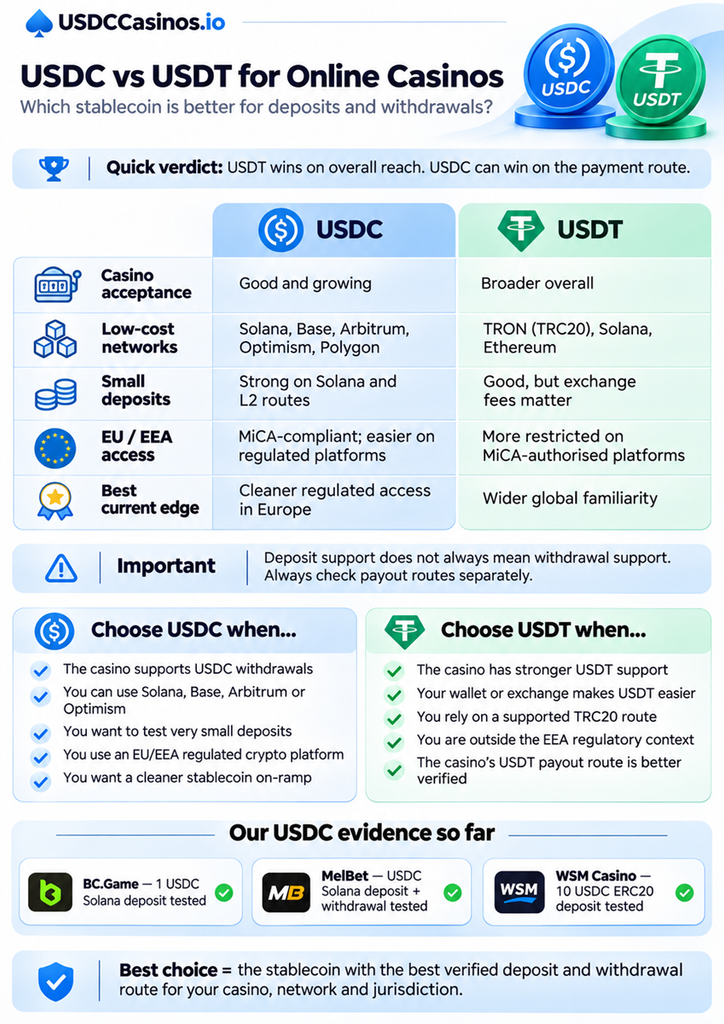
USDC vs USDT for Casino Payments: Quick Verdict
| Factor | USDC | USDT |
|---|---|---|
| Overall casino acceptance | Good and growing | Broader overall |
| Low-cost network options | Solana, Base, Arbitrum, OP Mainnet, Polygon and others | TRON, Solana and several other chains |
| Very small deposits | Strong when Solana or L2 routes are supported | Can be good, but sending-platform fees matter |
| EU/EEA regulated-platform access | Strong – MiCA compliant | More restricted on MiCA-authorised platforms |
| Global exchange/wallet adoption | Very strong | Wider overall |
| TRC20 route | Not a standard current native-USDC route | Major USDT route |
| Our current casino testing | Real deposits and withdrawals completed | Broader evidence exists across our other projects, but USDCCasinos.io is currently testing USDC first |
Our view: USDT still wins on overall global adoption and casino familiarity. USDC can be the better payment route when the casino supports it properly – especially over Solana or low-cost Ethereum Layer 2 networks – and it now has a meaningful access advantage for users of regulated crypto platforms in the EU/EEA.
What Is the Difference Between USDC and USDT?
Both tokens are designed to track the U.S. dollar, but they are issued by different companies and operate within different regulatory and blockchain ecosystems. USDC is issued by Circle, while USDT is issued by Tether.
For casino users, issuer differences matter less day to day than where the token can be bought, which blockchain route is available, whether the casino supports withdrawals and what fee the sending wallet or exchange charges. A player depositing 10 USDC over Solana may have a very different experience from someone sending 10 USDT over TRON or Ethereum.
Tether describes USD₮ as its most widely adopted stablecoin and supports it across multiple blockchain protocols, including Ethereum, TRON and Solana. Circle supports native USDC across a broad set of networks including Ethereum, Solana, Base, Arbitrum, OP Mainnet and Polygon PoS. For a detailed casino-focused breakdown, see our USDC casino networks guide.
Casino Acceptance: USDT Still Has the Wider Footprint
USDT has been used in crypto gambling for longer and remains the more familiar stablecoin at many offshore casinos. It is commonly shown alongside Bitcoin and Ethereum in crypto cashiers, and its broad exchange and wallet adoption makes it easy to source in many markets.
USDC support is increasingly common, but the quality of that support varies. A casino may advertise USDC yet expose only one network, accept deposits but not withdrawals, or convert the deposit into a fiat account balance rather than keeping USDC as the account currency.
That is why USDCCasinos.io does not rank a casino simply because a logo appears in the cashier. At BC.Game, for example, we saw 15 USDC routes and completed a real 1 USDC Solana deposit. At MelBet, we verified five USDC deposit and withdrawal routes and completed both a Solana deposit and withdrawal. At WSM Casino, we completed a 10 USDC ERC20 deposit.
USDC vs USDT Networks
Network choice can matter more than the stablecoin itself. The same 10-dollar value can be cheap and fast to move on one chain but inefficient on another.
| Network / route | USDC | USDT | Casino-payment view |
|---|---|---|---|
| Solana | Native USDC; strong support in our tests | Supported by Tether | Excellent for small transfers when supported |
| Ethereum ERC20 | Widely supported | Widely supported | Good compatibility; fees are more variable |
| Base | Native USDC | Not a core Tether route in the same way | Strong USDC option where casinos support it |
| Arbitrum | Native USDC | Availability varies by platform | Low-cost USDC route at supported casinos |
| OP Mainnet / Optimism | Native USDC | Availability varies by platform | Low-cost USDC route at supported casinos |
| TRON / TRC20 | Circle discontinued native USDC on TRON | Major USDT route | Still highly relevant to USDT casino users |
USDT’s biggest network-specific advantage in the casino market is still TRC20 familiarity. Many casino users know the route, and many exchanges and wallets support it. USDC’s strongest practical alternatives are increasingly Solana and low-cost Layer 2 networks such as Base, Arbitrum and OP Mainnet.
USDC Solana vs USDT TRC20 for Casino Deposits
This is a more useful comparison for many players than simply asking “USDC or USDT?” Both routes are designed for efficient value transfer, but the final cost shown by your wallet or exchange can differ substantially.
Solana’s underlying network fees are generally extremely low. In our own casino testing, BC.Game credited a 1 USDC Solana deposit in about 2 seconds, while MelBet credited our USDC Solana deposit in about 5 seconds. We also completed a real MelBet USDC Solana withdrawal within the same minute.
USDT TRC20 can also be efficient, but users should not confuse the underlying blockchain cost with the withdrawal fee charged by an exchange. A platform may apply a fixed USDT withdrawal charge that makes a 5- or 10-USDT transfer relatively expensive even when the blockchain itself is operating efficiently.
For small casino deposits, we would therefore compare the final fee displayed by the sending platform, not choose automatically based on the token or network name.
USDC vs USDT in Europe: MiCA Changes the Practical Choice
For users in the EU and EEA, this is now one of the most important differences between the two stablecoins.
On 8 October 2026, the European Securities and Markets Authority (ESMA) published supervisory expectations stating that crypto-asset service providers authorised under MiCA should cease providing services related to non-MiCA-compliant stablecoins to EU clients. ESMA says this reaches trading, exchange, execution, transfers, custody and other regulated crypto services. See the ESMA opinion and announcement.
This does not mean USDT is simply “banned in Europe.” The practical effect is that access through MiCA-authorised crypto platforms can be restricted. Existing exposures may be subject to tightly limited wind-down, conversion, withdrawal, transfer or safekeeping arrangements, but regulated providers are expected not to continue facilitating normal access to non-compliant stablecoins.
Coinbase provides a concrete example. Its EEA guidance lists USDT among MiCA non-compliant stablecoin assets and says affected balances had to be withdrawn by 30 October 2026, with remaining balances converted into USDC. See Coinbase’s EEA stablecoin guidance.
USDC is in a different position. Circle Internet Financial Europe SAS is authorised in France as an electronic money institution and issues USDC as a regulated e-money token under MiCA for EEA customers. Circle France also has authorisation to provide custody and transfer services for USDC across the EEA. See Circle France’s MiCA information.
For casino users, the implication is straightforward: the on-ramp and off-ramp may matter more than the casino. A casino may accept USDT perfectly well, but an EEA user relying on a regulated exchange may find USDT harder to buy, hold, transfer or cash out than USDC.
Which Is Better for EU Casino Players?
For an EEA-based user who funds a casino from a MiCA-regulated exchange, we would generally give USDC the practical advantage today. That does not mean USDT has stopped working globally or that self-custody users cannot hold it. It means the regulated access path is cleaner for USDC.
- USDC advantage: MiCA-compliant EEA issuance and stronger regulated-platform availability.
- USDT disadvantage: services involving USDT can be restricted at MiCA-authorised EU platforms.
- USDT still matters: it remains widely used globally and may remain easy to access outside regulated EEA platform channels.
Deposits Are Only Half the Comparison
A stablecoin is only useful for gambling if the payout route works too. Some casinos support a token or network for deposits but offer different options when you withdraw.
This is one reason we currently have stronger USDC evidence at MelBet than at BC.Game or WSM. We completed a real 87.86 USDC Solana withdrawal at MelBet. At BC.Game and WSM, we have verified USDC withdrawal routes and minimums in the cashier but have not yet completed the actual payout.
The same principle applies to USDT: never assume that because a casino accepts USDT-TRC20 deposits it will necessarily return funds over the same route, with the same minimum or with no additional verification.
Which Stablecoin Is Better for Small Deposits?
For a 1, 5, 10 or 20-dollar casino deposit, the network and sending-platform fee matter more than whether the token says USDC or USDT.
USDC has a strong small-deposit case when the casino supports Solana, Base, Arbitrum or OP Mainnet. We have already tested a real 1 USDC Solana deposit at BC.Game. Our low deposit USDC casinos guide compares the minimums and real tests in more detail.
USDT can also be efficient for small transfers, particularly when the user’s exchange offers a low-fee route. But a fixed exchange withdrawal charge can erase the advantage of a cheap underlying blockchain. Always compare the final amount you will receive at the casino.
Bonuses: Does USDC or USDT Qualify More Often?
There is no universal rule. Casino promotions can treat stablecoin deposits differently depending on the operator, account currency, country and campaign.
At some casinos, any eligible crypto deposit can trigger the same promotion. At others, the bonus is credited in the account currency after the stablecoin deposit is converted. Minimum qualifying deposits can also be higher than the normal cashier minimum.
For that reason, we do not award USDC or USDT an automatic bonus advantage. The correct comparison is whether the specific stablecoin deposit you intend to make qualifies for the current offer and whether the wagering and withdrawal conditions are reasonable.
Account Currency: Keeping USDC or Converting It
Another difference is how the casino handles the balance after deposit. WSM Casino allowed us to use USDC as the account currency itself. MelBet instead converts incoming USDC into the account currency selected at registration.
The same issue can arise with USDT. A crypto cashier may accept the token while the casino ledger runs in EUR, USD or another currency. That can introduce conversion rates and make the stablecoin function more like a funding rail than the actual gambling balance.
USDC or USDT: Which Should You Choose?
Choose USDC when:
- Your casino has verified USDC deposits and withdrawals.
- You can use Solana, Base, Arbitrum, OP Mainnet or another low-cost supported route.
- You use an EU/EEA-regulated crypto platform and want the cleaner MiCA-compatible route.
- You want to test with a very small deposit and USDC network fees are lower.
- The casino can keep USDC as your account currency or converts it on acceptable terms.
Choose USDT when:
- The casino has stronger USDT support than USDC.
- Your wallet or exchange makes USDT easier or cheaper to send.
- You specifically rely on a supported USDT route such as TRC20 or Solana.
- You are outside the EEA regulatory context or use a service where USDT access is not restricted.
- The casino’s USDT payout route is better verified than its USDC route.
Our Final Verdict: USDT Wins Reach, USDC Can Win the Payment Route
USDT remains the more widely adopted stablecoin globally and still has a broader footprint across crypto exchanges, wallets and many casinos. That makes it the default stablecoin at a large number of gambling sites.
But broader adoption does not automatically mean a better transaction. USDC can be the better casino payment option when the operator supports it properly, especially over Solana or low-cost Layer 2 networks. For EEA users, MiCA adds another practical advantage because regulated-platform access to USDC is materially cleaner than access to non-compliant stablecoins such as USDT.
Our preference is therefore not “always use USDC.” It is: choose the stablecoin with the best verified deposit and withdrawal route for your casino, wallet, network and jurisdiction.
USDC vs USDT Casino FAQ
Is USDC or USDT better for online casinos?
It depends on the casino and how you fund it. USDT generally has broader global adoption, while USDC can be especially attractive when a casino supports low-cost networks such as Solana, Base, Arbitrum or OP Mainnet and when the player uses an EEA-regulated crypto platform.
Is USDT banned in the EU?
No. USDT is not subject to a blanket consumer possession ban. However, MiCA-authorised crypto-asset service providers in the EU are expected to stop providing services involving non-MiCA-compliant stablecoins. This can restrict buying, trading, custody, transfers and other platform services for USDT in the EEA.
Is USDC MiCA compliant in Europe?
Yes. Circle Internet Financial Europe SAS is authorised in France as an electronic money institution and issues USDC as a regulated e-money token under MiCA in the EEA. Circle France also has authorisation to provide relevant crypto-asset services across the EEA.
Why is USDT still popular for casino payments?
USDT has very broad global adoption across exchanges, wallets and payment services, and many crypto casinos have supported it for years. TRC20 has also been a familiar route for casino users, although exchange withdrawal fees can make small transfers relatively expensive.
Is USDC cheaper to send than USDT?
The token name alone does not determine the fee; the network and the sending platform do. USDC on Solana or supported Ethereum Layer 2 networks can be extremely cheap. USDT can also be inexpensive on networks such as Solana or TRON, but wallets and exchanges may add their own withdrawal fees.
Is USDT TRC20 cheaper than USDC Solana?
Not necessarily. TRON can provide efficient transfers, but many exchanges apply a separate fixed USDT-TRC20 withdrawal charge. Solana network fees are generally extremely low, so USDC on Solana can be more economical for small transfers when both the exchange and casino support it.
Can I withdraw in the same stablecoin I deposited?
Not always. Casinos can support a token or network for deposits without offering the same route for withdrawals. We verify deposit and withdrawal support separately in our casino reviews.
Which stablecoin is better for EU casino players?
USDC often has a practical access advantage for EEA users because it is MiCA compliant and remains supported by regulated EU crypto platforms. USDT can still be used in other contexts, but access through MiCA-authorised service providers may be restricted.
